Town of Salem and the Mafia-Game Renaissance
How a free browser game inherited the social-deduction lineage from Mafia and tabletop Werewolf — and exported it to a global player base.
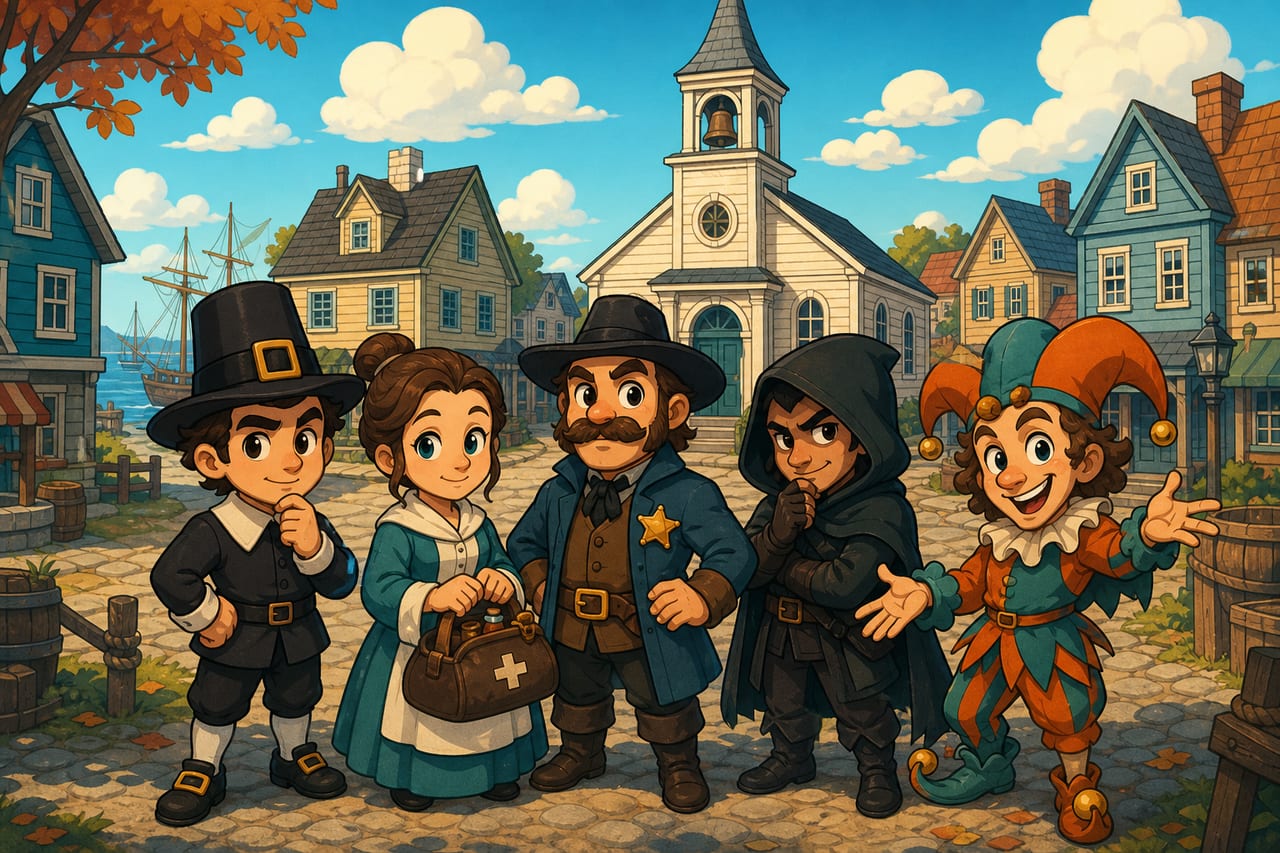
Most discussions of online gaming default to the long-session, mechanically demanding titles that dominate Twitch dashboards and esports calendars. World of Warcraft, Dota 2, Overwatch, and Counter-Strike operate at a scale and intensity that requires real time investment to be enjoyed.
Sitting alongside that category — and rarely included in the same conversation — is a different kind of online game. It is best played in short bursts, depends almost entirely on text-based communication, and produces drama through misdirection rather than mechanical execution. The reference point for this genre, in the second half of the 2010s, was Town of Salem.
The lineage
Town of Salem, developed by BlankMediaGames and released through a free-to-play browser client in 2014, is a direct descendant of the parlour game Mafia, which the Soviet psychology academic Dimitry Davidoff is credited with formalising in 1986. Variants known internationally as Werewolf, One Night, and Are You The Werewolf? moved through tabletop convention circles in the 1990s and into casual social-game collections in the 2000s.
Each version follows the same shape. A small population is invaded by hidden hostile players. The hostile players know each other’s identities; the rest of the population does not. The game proceeds in alternating day and night phases. By day, the players debate and vote on whom to remove; by night, the hidden players eliminate someone of their own choosing.
Town of Salem extended the framework by adding fifteen player slots, individually assigned roles with active abilities, and a written “last will” that surviving players could read after a death.
Role design
A standard Town of Salem match assigns nine players to the Town faction, three to the Mafia, and three to a wildcard tier. Each role brings a different active power.
On the Town side, the Doctor heals a chosen player at night, blocking that night’s Mafia kill. The Jailor selects a player to imprison and interrogate; if the Jailor concludes the prisoner is hostile, the prisoner can be executed during the night phase. The Investigator gathers role hints over multiple nights. The Sheriff checks whether a chosen player is “suspicious” — a fast but limited binary signal. The Lookout watches a chosen target and reports who else visited them that night. The composition of any given Town varies, which means that the early-game phase often involves players trying to establish, through claims and counter-claims, which protective roles are in play at all.
The Mafia faction wakes simultaneously each night, knows the identities of its three members, and selects a single target. Mafia players publicly claim Town roles during the day phase and lie consistently about what they did the previous night.
The wildcard roles change the social calculus entirely. The Executioner is privately assigned a Town target on game start and wins if that target is voted out by the Town itself. The Jester wins if voted out under any circumstance, which means a Jester’s goal is to act suspiciously enough to be lynched but not so suspiciously that the Town suspects the trap. The Serial Killer wins alone, kills one player per night, and is hostile to both Town and Mafia.
Day, night, and the will
A Town of Salem day phase consists of open discussion in a shared text channel, followed by an accusation vote. A player who receives accusation votes from more than half the surviving population is put on a public trial. During the trial, the accused offers a defence — also in chat — and the surviving players vote guilty, innocent, or abstain. A guilty verdict triggers immediate execution. The dead player’s last will is then displayed for the survivors to read.
This last-will mechanic is the social engine of the game. A player who knows they are likely to die will use their will to document role checks, suspicions, and Mafia identifications, so that the Town can act on the information after they are gone. The reverse is also possible. A Mafia member who anticipates being voted out can write a will that frames an innocent Town player as the Serial Killer. A skilled Mafia or Jester will draft a misleading will far in advance, knowing that the survivors will treat its contents as the testimony of someone who has nothing left to gain.
Why the format spread
Several factors explain why Town of Salem — and the broader Mafia-style social deduction genre — accumulated player counts in the millions through the second half of the 2010s.
The game runs in a web browser without installation. A typical match lasts fifteen to twenty minutes, which is shorter than the warm-up phase of most session-based shooters. The cost of joining is nothing. The skill ceiling, however, is unusually high: experienced players read patterns in vote timing, will phrasing, and behavioural inconsistency that newer players cannot reliably reproduce.
The game also has no headshot. Outcomes turn on persuasion, suspicion, and short-form writing. Players who do not enjoy mechanical action games, but who do enjoy puzzles, social inference, or competitive arguing, found in Town of Salem one of the few mainstream online titles for which their existing skills transferred directly.
Where the genre went
Town of Salem was not a single event. By 2018 the same template had reached console releases (Werewolf Online, various Mafia board game adaptations), formal tabletop reprints, and a viral social-deduction wave on streaming platforms. The 2020 release of Among Us brought the same loop — hidden hostile players, day-phase voting, defence speeches, suspicion modelled in chat — to a far larger audience. The visual presentation differed, but the underlying mechanics had been worked out two decades earlier and stress-tested in browser tabs and college common rooms long before Among Us normalised them for a streaming audience.
Players approaching the genre today have a wider range of options than Town of Salem presented in 2014. The original, however, remains a clear example of how a small browser-game team can build on a parlour-game tradition and produce a competitive online format with no shooting, no graphics race, and no per-session cost — but with a stake of social attention that long-format games rarely match.