Forgotten Aesthetics of the Early Web
Animated GIFs, tiled backgrounds, marquee tags — a visual vocabulary the modern web quietly disowned.
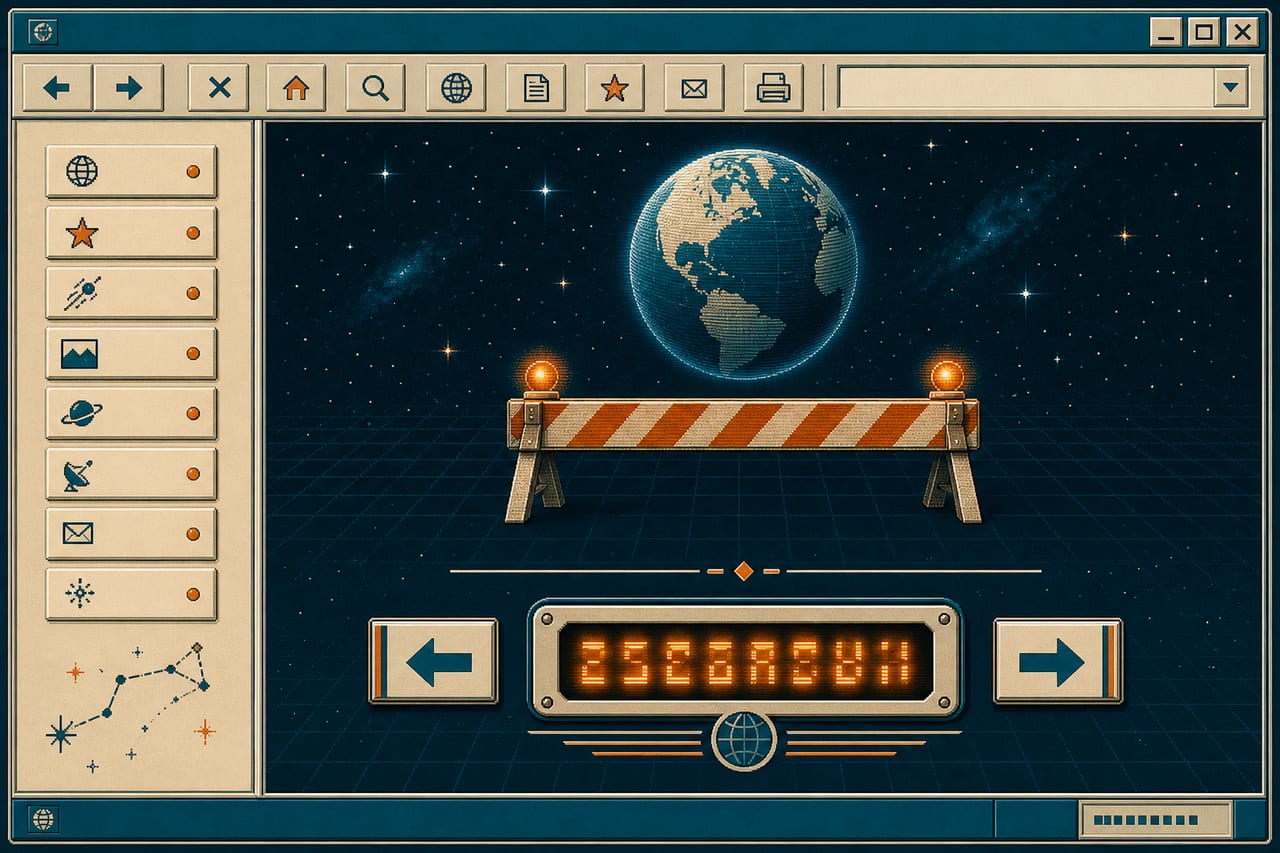
The pre-2005 web had a visual style that, in retrospect, is unmistakable. A site from 1998 cannot easily be passed off as a site from 2020. The technical reasons for this are clear — the underlying tools, file formats, and screen resolutions all changed — but the shift in taste was equally important, and is sometimes harder to reconstruct.
This piece looks at six elements that defined the aesthetic of the first decade of the public web and that have largely been retired from contemporary practice.
Tiled backgrounds
A small image file — typically between 32×32 and 200×200 pixels, often a textured swirl, a parchment scrap, or a starfield — set with the HTML attribute background="texture.gif" would tile to fill the browser window. Loading times on dial-up connections favoured small files; tiling a small file across an arbitrary screen size was a practical solution to “how do you visually fill a page” before CSS gradients existed.
The result was that personal sites, fan pages, and small-business sites all carried distinctive tiling textures the way a 1970s living room carried wallpaper. The texture was sometimes thematic — a chessboard for a chess fan site, a galaxy of stars for a science-fiction archive — and sometimes purely decorative.
CSS-supported solid colours, gradient fills, and high-resolution full-bleed images eventually pushed tiling out of fashion. By the mid-2000s a tiled background read as visually loud rather than visually present.
Animated GIFs as ornament
Before HTML5 video, before CSS animation, and before JavaScript was reliably used for visual effects, the animated GIF was the only widely-supported way to put motion on a page. A turning logo, a flickering candle, a “Under Construction” banner with a worker swinging a hammer — these existed because the GIF format supported a sequence of frames inside a single static-file declaration.
GIF ornaments were also small enough to download. A four-frame, sixteen-colour animated GIF could be under ten kilobytes — small enough to load in seconds on a 28.8k modem. The format itself remains in use, but its decorative role on personal pages has been transferred to short videos, Lottie animations, and CSS keyframes. The flickering candle in the sidebar is gone; the flickering candle as a stylistic memory is what remains.
The <marquee> and <blink> tags
Two non-standard HTML elements, introduced respectively by Microsoft Internet Explorer and Netscape Navigator, became defining markers of the early web. <marquee> scrolled its contents horizontally across the page. <blink> toggled its contents between visible and invisible roughly twice a second.
Neither tag was ever part of the official HTML specification. Both were widely used. The marquee, in particular, was the obvious solution to displaying “news” on a small commercial page when the author had no JavaScript skills and no live data source. Marquees announced opening hours, special offers, and “welcome to our website” greetings.
Modern browsers still render <marquee> for backwards compatibility, though the element is formally obsolete and triggers accessibility warnings. <blink> has been removed entirely from all major browsers. Both tags have moved from “ordinary tools of the trade” to “stylistic artefacts” within a single working generation.
Frames
The HTML <frameset> and <frame> elements partitioned the browser window into multiple independent sub-windows, each loading a different URL. The standard layout — a top navigation strip, a left-side menu, and a main content area — gave the appearance of a desktop application running in a browser.
Frames had structural problems that the early web largely tolerated and the later web could not. Each sub-frame had its own URL, which meant that a deep-linked address would land in a sub-frame without the surrounding navigation, and that bookmarking a deep page reliably required workarounds. Search engines indexed the inner frames as standalone documents, often returning a result that loaded as a fragment without the parent layout. The arrival of CSS layout in the late 1990s and reliable server-side templating in the early 2000s made <frameset> redundant. By the time HTML5 deprecated it formally, frames had already been gone from new sites for years.
Visitor counters
A small image — usually displaying a six-digit number against a black background, often with an LED-style numeric font — sat at the bottom of a personal site and incremented every time a visitor loaded the page. The counter was generated server-side by free services such as Site Meter, FastCounter, or the early version of NedStat.
The visitor counter was an honest signal. The site owner could not see who was visiting, but anyone visiting could see roughly how many other people had. A counter at “00012,047” implied a site that had accumulated some readership; a counter at “00000087” implied a site the visitor was effectively early to.
The visitor counter as a visible element disappeared as analytics platforms moved behind dashboards that only the site owner saw. The information did not vanish; the social signal did.
The webring
A webring linked together a set of sites on a shared theme — for instance, fans of a particular band, regional dialect speakers, or hobbyists in a niche craft — through a navigation widget at the bottom of each member site. The widget offered “Previous,” “Next,” “Random,” and “List All” links, all routed through a central index page maintained by the ring owner.
A webring functioned both as a discovery tool and as a form of mutual citation. Joining one was an act of declaration: this site belongs to that community. By the early 2010s the webring as an infrastructure had been almost entirely superseded by topic-tag search, blogroll links, and platform recommendation engines. A handful of small webrings still operate, frequently as a deliberate stylistic gesture toward this earlier convention.
What the aesthetic added up to
These six elements, taken together, suggest a web that was visually busy by modern standards but socially modest. Personal sites used decorative tiling, animated ornaments, and visitor counters not because their authors expected mass audiences, but precisely because they did not. The page was a small, decorated room — a hand-built space rather than a content-delivery surface.
Contemporary design conventions optimise for a different problem: large audiences, mobile screens, accessibility compliance, and high information density per square centimetre. The trade-offs are clear, and they have generally been worth it. But the visual vocabulary that the early web disowned is worth examining on its own terms, not as a failed prototype of the present, but as a fully working solution to a different question.