Emblematic Video Games from the 90s
From DOOM's shareware revolution to the LAN-party rituals of Quake — a look at the titles that defined a decade of PC and console identity.
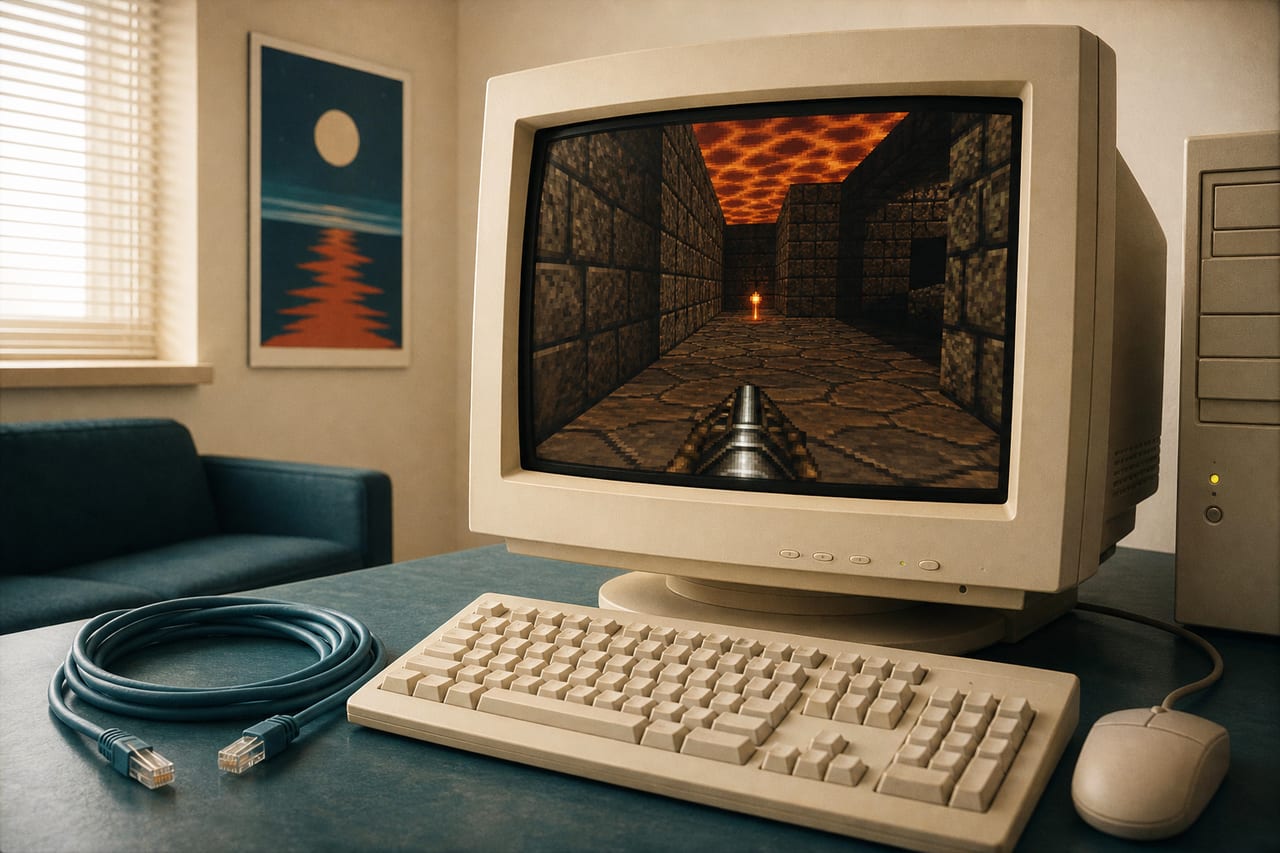
The 1990s were the decade in which video games stopped being a peripheral hobby and became a defining feature of mainstream culture. The arrival of 32-bit and 64-bit consoles, the rapid maturing of the personal computer as a gaming platform, and the early conventions of online multiplayer all converged inside a single ten-year stretch. The titles below are not the only important games of the era, but each one captured something specific about how players, developers, and publishers were thinking at the time.
DOOM (1993)
id Software released DOOM through a shareware model that effectively turned the first episode into a free demo distributed on floppy disks, university file servers, and bulletin-board systems. The full game was sold by mail order. Within months, DOOM had been installed on more PCs than the contemporary release of Windows, and the term “DOOM clone” entered the trade press as shorthand for the first-person shooter genre that the title essentially codified.
Beyond the technical accomplishment — fluid texture-mapped 3D rendering on consumer hardware that had no dedicated graphics acceleration — DOOM shipped with WAD-file support for user-made levels. This was the catalyst for a modding scene that has continued, without serious interruption, for more than three decades.
Super Mario 64 (1996)
Nintendo’s launch title for the Nintendo 64 took the design vocabulary of 2D platforming and rebuilt it for three dimensions in a single, confident step. The analog stick, debuted with the same console, mapped directly onto Mario’s variable walking, running, and tiptoeing speeds. Camera control, a problem the industry was still solving, was assigned to its own set of inputs.
Subsequent 3D platformers, regardless of publisher, borrowed the structure of self-contained levels accessed from a central hub world. Super Mario 64 is one of the few games of the decade whose template is still legible in releases shipping today.
Quake (1996)
If DOOM established the first-person shooter, Quake established the LAN party. id Software’s follow-up moved from sprite-based enemies to fully polygonal models, and — more importantly — from local multiplayer to networked deathmatch played over IPX or early TCP/IP connections.
In college dormitories and shared houses across North America and Europe, players hauled tower PCs and CRT monitors to a single room, ran category-5 cable across the floor, and played for whole weekends. The QuakeWorld client, released the following year, added prediction code that made internet play viable over dial-up modems for the first time. The competitive Quake scene that emerged is generally treated as the starting point of organized PC esports.
StarCraft (1998)
Blizzard’s real-time strategy title shipped with three asymmetric playable factions whose units, resources, and tech trees had no direct equivalents on the opposing sides. The asymmetry was unusual at the time — most strategy games of the period offered cosmetic faction differences over a shared rule set — and it required years of patch work to balance.
The game’s adoption in South Korea was extraordinary. By the early 2000s, two cable television channels broadcast StarCraft matches full-time, professional player salaries were sponsored by domestic telecoms, and the game functioned as a recognised national sport. The Korean StarCraft league outlasted the original game by several years and only formally wound down after StarCraft II had been available for over a decade.
Final Fantasy VII (1997)
Square’s seventh entry in the Final Fantasy series shipped on three CD-ROMs for the original PlayStation, with pre-rendered backgrounds, fully animated cutscenes, and an orchestral-quality soundtrack delivered through CD audio. For a great many North American and European players, this was the first Japanese role-playing game that arrived alongside the marketing budget of an action blockbuster.
The story’s central death scene became one of the defining “spoiler” moments of the decade — an event widely discussed in school playgrounds and in early web forums before the player could reasonably encounter it themselves. Final Fantasy VII is also frequently cited as the title that made cinematic in-game storytelling a default expectation rather than a novelty.
Ultima Online (1997) and EverQuest (1999)
The massively multiplayer online RPG existed in primitive form before the late 1990s, but Ultima Online in 1997 and EverQuest in 1999 were the two releases that turned the concept into a commercial product with persistent subscriptions, monthly billing, and dedicated server hardware.
Ultima Online was player-driven to a degree that the genre rarely repeated: open-world player-versus-player combat, full housing simulation, and an in-game economy that emergent player-run guilds either policed or exploited. EverQuest refined the formula into the dungeon-and-raid loop that World of Warcraft would adopt and popularise in 2004. Almost every subsequent persistent-world game is in conversation with one or the other.
Half-Life (1998)
Valve’s debut shipped at the very end of the decade and effectively reset the standard for first-person narrative. Half-Life eliminated the cutscene as a distinct mode: every story beat played out inside the player’s continuous first-person view, without losing control of the avatar. Scripted set pieces — a colleague being killed in front of the player, a train arriving on a platform — replaced what had previously been delivered through full-motion video or pre-rendered animation.
The modding community that Half-Life shipped with produced Counter-Strike, Team Fortress, and Day of Defeat. Each of these mods grew larger than most independent releases of the period.
What the decade left behind
Looking at this list with the benefit of distance, three patterns stand out.
First, the 1990s normalised the idea that a video game could be a developer-led artistic statement rather than a publisher-led product, and that the developer’s name belonged on the box. id, Blizzard, Nintendo, Square, and Valve all became consumer-recognised brand identities during this period.
Second, the era introduced the idea that a game’s life extended past its release date through patches, expansions, and online play. The shrink-wrapped, finished-on-shipping disk that defined the 1980s home computer game gave way to a model in which the disk was a starting condition.
Third, and most quietly, the decade established the conventions of the modern gaming press — both the magazine reviewers who had to file copy on time and the early web forums where players themselves did the cataloguing. Many of the lists, rankings, and canonical opinions still in circulation today were first drafted between 1993 and 1999. The games above are not on this list because consensus has confirmed them. They are on this list because the consensus, in many cases, was built around them while the decade was still in progress.